Sunday, October 28, 2018

Kohawk Startup 2018

Elizabeth Hoover de Galvez, Head of Reference, attended Kohawk Startup 2018 to provide research assistance to teams who had less than 24 hours to take an idea and turn it into a prototype and polished 5-minute pitch.  Hoover de Galvez describes her experience below: 

I attended because I wanted to support this great event in whatever way I could.  It was also an opportunity for me to learn more about startup events and to see Coe students in action.  An additional benefit was learning about NewBoCo, which is an incredible resource for Iowa, based in Cedar Rapids, with a mission to accelerate world-changing ideas from Iowa.  I was really impressed with the mentors who volunteered their time to assist students in developing their ideas, including Sumit Nijhawan '93, CEO of Ruffalo Noel Levitz, and David Mehaffy '76.

In the initial pitching round, I participated and gave a one-minute pitch for a product idea (a magnetic back-up camera for older cars which transmits to a phone app).  I discovered soon after I had pitched that this product had already been invented.  That was one of the great things about the event: you could pitch an idea and get instant feedback from the group.  Then, if you decided to go forward with the idea, you had to convince a team (at least one other person) to work with you.  This format provided a chance to view your own idea objectively and to compare it with others' ideas.

As a librarian, the research phase was great.  I chatted with each of the eight teams about some of the questions they were struggling to find the answers to.  I tried to find each group an industry report from our new IBISWorld Database subscription (you'll need to login or be on campus to use it).  Then, in the time I had left, I started looking for other resources--scholarly articles, dissertations, patents, etc.  One day isn't enough time to dig deeply or read thoroughly the published research, so the time constraint really added a new dimension to the work.  The students were also encouraged to complete some original research as part of the process--go out and survey their target consumers, for example.  One group cut up pens to calculate the weight of the plastic being wasted in disposable pens.  Another group surveyed 55 students about the ride-sharing services they currently use.  A third group reached out to Iowa's Secretary of State and got positive feedback about their voting app.  A fourth group 3D printed a prototype of their fitness tracker in the Library's MakerStudio.  It was incredible what they were able to achieve in less than 24 hours. 
I told a couple of groups that I would be first in line as a customer.  I'm really looking forward to having a device on my bike which tracks how many miles I'm riding without me needing to get out my phone to start a tracker.  I'm also excited about a restaurant ratings app which learns from your ratings and will suggest a local restaurant each month where I can get a free meal for a low monthly fee (I get paralyzed by choice and hate wasting time reading reviews, so I usually eat at the same place over and over).  And I'd love an app which simplifies the process of doing research about local candidates before I go to the polls. 
Overall, the inaugural startup weekend was a fantastic success and the Center for Creativity & Careers hopes to offer the event again next year.

More details about the event

On October 26-27, Coe College's Center for Creativity & Careers co-director's Andrea Kann & Barb Tupper organized a 24-hour innovation event "designed to infuse entrepreneurship into the Coe Experience".  The event was lead by David Tominsky '98, the Accelerator Managing Director at NewBoCo (or New Bohemian Innovation Collaborative).  Students were able to attend at no charge thanks to funding from David Mehaffy '76, with support from Coe College Center for Creativity & Careers and the Coe College Alumni Association.  

Friday evening started out with some practice pitches before students, mentors, and audience members had one minute each to pitch real ideas.  Twenty-two ideas were pitched, voted on, and winnowed down to ten ideas.  Participants could then choose a team/idea to work on, which resulted in the formation of eight teams.  

The teams worked together Friday evening and all day Saturday to put a plan into action.  They received coaching from alumni who served as mentors, and research help from a librarian.  They created prototypes and presentations of their products and were encouraged to go out and survey their target market.  Starting at 4 PM on Saturday each team had 5 minutes to pitch to a panel of four judges.


The Teams & their Ideas

Promoting Genius (Dominic Slouca, Yuulin An, Anushree Dhawan, Donald Bell)
A platform for employers to search for employees 
ScoopMe (JT Henry, Brooke Ransom, Joshua Gonzales, Kyle Goranson)
A free ride service for students, by students 
Safe Haven Coffee Shop (Leah Shaffer, Erika Perlewitz, Ha Nguyen, Morgan Hendricks, Karly Arnaiz-Palacios)
A study space to study safe, stress-free, 24-7 
PenLess (Derek Benavidez, Quincy Markham)
A refillable ink pen mail-order service designed to reduce plastic waste from disposable pens. 
New Age Communication (Haley Luna, Matthew Siegel, Jeremy Lewis, Grant Finneman)
Service to facilitate intergenerational communication in the workplace 
PolPlace: Revolutionizing the way you vote local (Sabrina Gallardo, Bailey Finken, Stephen Green, MacKenzie Gustafson, Jalisa Hunter)
A user-friendly app to explore non-partisan information on local elections and candidates 
LOOP or Live Optimized Online Partner (Christian Chiffy, Collin Flynn)
A one-button route/mileage tracker for your bike 
Ratings for You (Ian Slagle, Tomo Takebuchi)
A restaurant review platform

David Tominsky shared that his least favorite part of the weekend was announcing the judges choices for prizes.  He believes that all teams did a great job and just because they aren't named as "winners" doesn't make them losers.


  • $1,000 was awarded to ScoopMe
  • $500 was awarded to PolPlace

Friday, October 6, 2017

The triage of truth: do not take expert opinion lying down (by Julian Baggini, originally posted on AEON)

Note: As a librarian, I'm very interested in finding the truth in all of the books, articles, and sources which the library provides for our users.  I tell students that scholarly & peer reviewed sources are more trustworthy, but those sources too have flaws and are sometimes so hard to understand that we fall back on reading an experts interpretation of the original research.  But under what circumstances can we trust the experts? 

The article below wrestles with that question.  It was originally posted on AEON and is being republished here under Creative Commons. 

The thirst for knowledge is one of humankind’s noblest appetites. Our desire to sate it, however, sometimes leads us to imbibe falsehoods bottled as truth. The so-called Information Age is too often a Misinformation Age.
 There is so much that we don’t know that giving up on experts would be to overreach our own competency. However, not everyone who claims to be an expert is one, so when we are not experts ourselves, we can decide who counts as an expert only with the help of the opinions of other experts. In other words, we have to choose which experts to trust in order to decide which experts to trust.
Jean-Paul Sartre captured the unavoidable responsibility this places on us when he wrote in Existentialism and Humanism (1945): ‘If you seek counsel – from a priest, for example – you have selected that priest; and at bottom you already knew, more or less, what he would advise.’
The pessimistic interpretation of this is that the appeal to expertise is therefore a charade. Psychologists have repeatedly demonstrated the power of motivated thinking and confirmation bias. People cherry-pick the authorities who support what they already believe. If majority opinion is on their side, they will cite the quantity of evidence behind them. If the majority is against them, they will cite the quality of evidence behind them, pointing out that truth is not a democracy. Authorities are not used to guide us towards the truth but to justify what we already believe the truth to be.
If we are sincerely interested in the truth, however, we can use expert opinion more objectively without either giving up our rational autonomy or giving in to our preconceptions. I’ve developed a simple three-step heuristic I’ve dubbed ‘The Triage of Truth’ which can give us a way of deciding whom to listen to about how the world is. The original meaning of triage is to sort according to quality and the term is most familiar today in the medical context of determining the urgency of treatment required. It’s not infallible; it’s not an alternative to thinking for yourself; but it should at least prevent us making some avoidable mistakes. The triage asks three questions:
  • Are there any experts in this field?
  • Which kind of expert in this area should I choose?
  • Which particular expert is worth listening to here?
In many cases there is no simple yes or no answer. Economic forecasting, for example, admits of only very limited mastery. If you are not religious, on the other hand, then no theologian or priest can be an expert on God’s will.
If there is genuine expertise to be had, the second stage is to ask what kind of expert is trustworthy in that domain, to the degree that the domain allows of expertise at all. In health, for example, there are doctors with standard medical training but also herbalists, homeopaths, chiropractors, reiki healers. If we have good reason to dismiss any of these modalities then we can dismiss any particular practitioner without needing to give them a personal assessment.
Once we have decided that there are groups of experts in a domain, the third stage of triage is to ask which particular ones to trust. In some cases, this is easy enough. Any qualified dentist should be good enough, and we might not have the luxury of picking and choosing anyway. When it comes to builders, however, some are clearly more professional than others.
The trickiest situations are where the domain admits significant differences of opinion. In medicine, for example, there is plenty of genuine expertise but the incomplete state of nutritional science, for example, means that we have to take much advice with a pinch of salt, including that on how big this pinch should be.
This triage is an iterative process in which shifts of opinion at one level lead to shifts at others. Our beliefs form complex holistic webs in which parts support each other. For example, we cannot decide in a vacuum whether there is any expertise to be had in any given domain. We will inevitably take into account the views of experts we already trust. Every new judgment feeds back, altering the next one.
Perhaps the most important principle to apply throughout the triage is the 18th-century Scottish philosopher David Hume’s maxim: ‘A wise man … proportions his belief to the evidence.’ Trust in experts always has to be proportionate. If my electrician warns me that touching a wire will electrocute me, I have no reason to doubt her. Any economic forecast, however, should be seen as indicating a probability at best, an educated guest at worst.
Proportionality also means granting only as much authority as is within an expert’s field. When an eminent scientist opines on ethics, for example, she is exceeding her professional scope. The same might be true of a philosopher talking about economics, so be cautious about some of what I have written, too.
This triage gives us a procedure but no algorithm. It does not dispense with the need to make judgments, it simply provides a framework to help us do so. To properly follow Immanuel Kant’s Enlightenment injunction ‘Sapere aude’ (Dare to know), we have to rely on both our own judgment and the judgment of others. We should not confuse thinking for ourselves with thinking by ourselves. Taking expert opinion seriously is not passing the buck. No one can make up your mind for you, unless you make up your mind to let them.Aeon counter – do not remove
Julian Baggini
This article was originally published at Aeon and has been republished under Creative Commons.

Monday, February 13, 2017

The Nuremberg Trials: Coe's Connection


In 1917, Benjamin DeWayne Silliman graduated from Coe College. Little did he know his remarkable career was just beginning. 

Silliman served in WWI for a short time before he returned to Cedar Rapids and taught debate at Washington High School. He received a degree in 1923 from the University of Iowa College of Law and then practiced law in Cedar Rapids and instructed at Coe part time.
He served shortly in WWII but was then assigned as Judge Advocate to Justice Robert Jackson and assistted with interrogations and prisoner transfer during the Nuremberg Trials. 
He returned to Cedar Rapids after the trials but brought many related artifacts with him. This included interrogations, prisoner information, trial notes, and even some Nazi passports and military insignia. Silliman left these items to Coe College when he passed away in 1988. To celebrate 100 years from his graduation and 85 years of the library's place on campus, we are happy to announce an exhibition running from February 16, 2017 to March 16, 2017 in the Cone Galleries on the main floor of the library. Come take a look at these items and learn more about Coe's Connection to the historical Nuremberg Trials. 


To learn more about the collection, visit the Silliman Finding Aid or stop by the George T Henry Archives in the lower level of the library. 

Friday, December 9, 2016

Book Suggestion


Paperwhite Narcissus
written by Tom Baker


Looking for a good book about self-discovery? Interested in keeping your brain engaged with a compelling novel during these snowy days? Paperwhite Narcissus might just be the book you’ve been looking for.
In this relatively short novel, we follow Tim as he navigates through his senior year of college. After the death of his mentor, Red Ryder, he tries to deal with her absence while also figuring out who he is. As if that weren’t enough, Tim is stuck deciding whether or not it is worth applying to graduate school, when the fear of being drafted into the military looms around him. This leads him on some strange adventures as he tries to uncover who he really is.

Come check out this book and many others over at the library! We’ve got many new books out on display that are ready to be checked out and read throughout the holiday season.

Tuesday, November 8, 2016

Native American Heritage Month Book Display


Red Bird Sings
Q. L. Pearce & Gina Capaldi


In honor of Native American Heritage month, Stewart Memorial Library has created a display to showcase some of the wonderful works about, or written by those of Native American decent. Stories both new and old, fictional and non, are out for your viewing pleasure on the main floor and the basement level of the library. 

One of these incredible works, Red Bird Sings written by Q. L. Pearce and illustrated by Gina Capaldi. This captivating picture book tells the tale of Zitkala-Ša, a poet (whose work you can also check out at our display), activist, and musician who is trying to find a way to speak her mind in a world ruled by oppressors. The reader travels with Zitkala-Ša as she grows, learns, and discovers her voice and potential in the world. Her drive to do more for herself, while also standing up for her people is what makes this piece so incredibly moving. And if her bravery and poise wasn’t enough, then the artistic illustrations just might do you in. 

Give yourself a break from all the cramming, writing, and stress of classes to come enjoy the tale of Zitkala-Ša and so many other Native Americans. All books are available for check out on the main floor. Don’t miss out!

-Review by library student worker Samantha Jankowski

Friday, August 26, 2016

Database Updates!

With the new school year here, we wanted to give all Kohawks a brief introduction to some changes in our database list. Find these on our home page under "All Databases"


Check out Birds of North America whether you're an aspiring ornithologist or just simply interested in topics about birds. BNA has some great resources like videos, charts, audio clips, and images to help you get familiar with the friendly fowl around us. 


Find Birds of North America here or in our All Databases list

_________________________________________________________________________
We've got a handy resource from ProQuest that can assist you with starting assignments. It's called Research Companion, and it's compiled into a friendly interface that provides videos, tables, and blurbs about different topics, how to evaluate sources, citation, and more. 

Few videos are longer than a couple of minutes, so you'll be on your way to a great assignment in no time!


Find Research Companion here or in our All Databases list

Monday, February 15, 2016

Washington's Birthday & the Colonial Ball

Happy Presidents Day! In her early days, Coe would celebrate George Washington's birthday with an assembly that included a debate and a reception hosted by the women students.

1893 Program

1892 Program


From a March 1, 1906  article in the Cosmos, it was mentioned that the women faculty and students of Williston Hall (the original women's dormitory) held a reception and provided refreshments and even little axes as souvenirs.

1924 Colonial Ball

Colonial Ball dance performance 1950s

Starting in 1911, the day's festivities concluded with the Colonial Ball. This was an even where the women students could show off their dance and athletic skills. They would dress in colonial costumes and perform for their fellow Kohawks and members of the public. Two senior women are honored by being named as George and Martha Washington. This tradition continued for many years, the final ball was held in February of 1961.

Friday, January 29, 2016

Marquis Court

Did you know in 1947, Coe arranged for 15 housing units for married veterans and their families? This allowed the vet to still easily attend classes at Coe. The units were built by the Federal Public Housing Authority and ownership was initially retained by the government until two years after the war, and then they belonged fully to Coe College.

A photo of the huts from the 1948 yearbook

Each unit (known as a Quonset hut) had two bedrooms, a living room with a kitchenette, two closets and a bathroom. The units also came furnished with a gas space heater, a stove, and a water heater. Bed linens, however, could be rented from the government if the couple wished!

It was named Marquis Court after a former president of Coe. The huts happily housed up to 26 couples and 7 children (Coe Cosmos October 18, 1950) as well as a canary, three dogs, and a skunk! Over time, the buildings became run down and housed fewer students, so they were finally abandoned and demolished in 1960.

A group of students and pets share dinner
Text from the 1949 Courier about the huts


Monday, December 14, 2015

Deck the halls with...art!

Paintings are hung on the walls with care, in hopes that student viewers soon will be there. The library's art collection has finally come back! Come on in during this busy finals season to relax while looking at beautiful Marvin Cone paintings, bright Andy Warhol prints, and more!

Reference and learning commons desk

Inside the Pochobradsky Reading Room


Outside the speaking center and library classroom


Lower level presentation wall


Monday, December 7, 2015

What do you do with withdrawn books during the holidays?


Make a tree! Circulation students built the tree out of withdrawn reference books and decorated it with photos and lights. The tree adds a merry decoration to the circulation area and is the perfect tree for a library. 

The construction process


Final product! Lookin' good.

Monday, November 23, 2015

A Few Research Tips for your Final Papers

Learn how to identify good websites:  If you are relying on and citing articles from about.com, FoxNews.com, MSNBC.com , Wikipedia, or similar websites, hit the brakes.  If the author or sponsoring organization isn't an unbiased, credentialed or recognized authority on the subject, then you probably shouldn't waste your time.

There are thousands of great websites which provide access to resources for college-level research.  Here are just a few:


Don't stop with websites: You can save yourself a lot of time by using library databases to complete your.research, so take advantage of them!  The databases provide access to published resources including scholarly articles and books, as well as advanced search features which make sorting and filtering your results a breeze.  One bonus feature of databases is that they often provide pre-formatted citations which you can use in your reference list (always double-check it for accuracy).

Know when and how to cite: Don't forget that in addition to the list of references at the end of your paper, you also need to include citations in the text of your paper whenever you use someone else's words or ideas (even if you are paraphrasing or summarizing in your own words); these citations may be in the form of footnotes, in-text citations, or parenthetical references, depending on the publication style you are using.

If you need help evaluating or citing sources, selecting a database, or using any library tools or resources, stop by the reference desk or talk to a librarian.

*This information also appeared in today's Learning Commons Newsletter, LC News which was emailed to all students, faculty, and staff.

Friday, November 20, 2015

Quick Reads

It's a busy time for college students: presentations, registration for next semester, essays, final exams, and so many other things. 

But one great way to relax is to lose yourself in a novel, and before you think you don't have any time to read, check out some of our recommendations for short novels that you can most likely read in just one sitting!

214 pages

This short young adult novel, We Have Always Lived in the Castle by Shirley Jackson is a story about an isolated, odd, and possibly murderous family and the weirdness that ensues when a cousin arrives for a visit. Find it on the third floor of the library with the call number PS3519.A392 W4. 

197 pages

Child of God by Cormac McCarthy is a little creepy, but in a good way. Lester Ballard, a man fasley accused of rape, is released from jail and attempts to return to life in East Tennessee. Find it on the third floor of the library with the call number PS3563.C337 C4 1993

219 pages
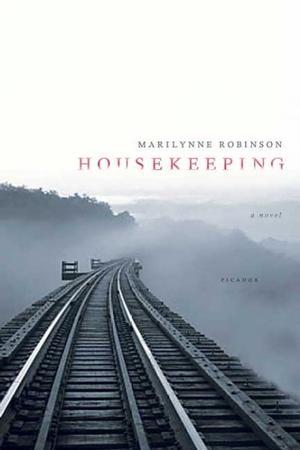
Housekeeping by Marilynne Robinson was nominated for the Pulitzer Prize and is the story of Ruth and her younger sister, Lucille, who grow up first with their competent grandmother, then two comically bumbling great-aunts, and finally of Sylvie, their eccentric and remote aunt. A great book about family, find it on the third floor of the library with the call number PS3568.O3125 H6 1980.


175 pages
In The Lime Twig, a group of crooks plan to steal and race a horse under a false name. Reviewers say it's strange and experimental, but well worth the read. And at only 175 pages, it wouldn't take long! Find it on the third floor of the library with the call number PS3558.A82 L5x

120 pages
Coming in at only 120 pages, Gabriel Garcia Marquez has written a great story about a man who returns to his hometown to solve a murder and is determined to get to the bottom of the story. Find Chronicle of a Death Foretold on the third floor of the library with the call number PQ8180.17.A73 C5 1983


Sit down with some turkey and pumpkin pie, and enjoy these great quick reads. Have a great Thanksgiving break, Kohawks!


Thursday, October 29, 2015

A real life "Room of Requirement"

Check it out Harry Potter fans: architect Gary Chang transformed his 345 square foot apartment into a real life room of requirement.

What's the room of requirement?  One of the characters in the book describes it as "a room that a person can only enter when they have real need of it. Sometimes it is there, and sometimes it is not, but when it appears, it is always equipped for the seeker's needs" (Harry Potter and the Order of the Phoenix, Chapter 18)

Chang's tiny apartment can transform into 24 separate spaces, depending on his current need.


You can check out photos and all of the possible configurations in this article from designboom architecture.

I found out about this apartment in a new youth book in the library, Take Shelter, At Home Around the World, by Nikki Tate and Dani Tate-Stratton.

Tuesday, August 25, 2015

New JSTOR Arts & Sciences Added to the Library


The Library has added JSTOR Arts & Sci­ence XIII and Arts & Sci­ence XIV to its col­lec­tions. At this time, 208 new titles have been added to the library catalog and are also accessible through Journal Titles on the library website. As with all of the JSTOR archive collections, these collections have an embargo (moving wall), which excludes the most recent (3-5) years of contents from the journals they contain.

JSTOR XIII expands its international set of journals in core humanities fields with emphases in Language & Literature, Philosophy, and Religion.  Represented subdisciplines include European church history and the literature of the American West. 

JSTOR XIV focuses on the study of culture and communication, specifically Archaeology and Anthropology, Language and Literature, Political Science, Asian Studies, Sociology, Education, and Communication Studies.

For a complete title list of these collections, please follow the links –

Monday, July 27, 2015

The "Good One" Club

Special Summer Series: Elizabeth Hoover de Galvez from the library's reference department, shares her observations of summer research at Coe. This summer she is working with Dr. Feller's materials science group.
It is inevitable that in a teaching lab, mistakes happen.  Students (and sometimes faculty) shatter, overheat, mislabel, and otherwise mess up.  As I started learning about the equipment in the physics lab, I sometimes felt paralyzed by all that could go wrong.  The way that the physics students handle these errors is with humor--by writing up a satirical account of the misdeed and posting in the halls of Peterson for all to see.  Then everyone can laugh about (and learn from) their mistakes together.    

Recent "good ones" (many of these may not be official "good ones" which get written up, but are just a few mistakes which have happened on the days I've been in the physics labs):

  • a sample of glass was mailed off to another university; the researchers started getting unexpected results in their tests.  It was finally discovered that the students who had made, packaged, and sent the samples had mislabeled one of them.
  • the scanning electron microscope was used to examine a sample which looked very strange under high-magnification.  After much head-scratching, it was discovered that the actual sample had been blown off of the viewing slide leaving only a highly magnified image of a piece of tape
  • the small enclosed furnace room reeked of ammonia after students heated a glass which contained (I believe) ammonium powder of some form
  • someone used highly flammable acetone cleaning solution in the furnace room
  • while working with hydrochloric acid to clean crucibles, a student left the water running alongside an uncapped bottle of acid.  The students that arrived later found a puddle which they had to verify wasn't acid before cleaning up.
  • the students also mentioned a couple of past accidents--melted platinum crucibles worth hundreds of dollars and equipment accidentally frozen by liquid nitrogen.   
When I first heard about the good one club, I was slightly uncomfortable with the idea; I am a fairly empathetic person and have been known to suffer from vicarious embarrassment.  But since learning that it is a somewhat formal/organized activity with support from faculty, I've decided that I'd prefer to have my mistakes broadcast openly with humor rather than whispered about.

Monday, July 6, 2015

Tellurium Glass--to England via Coe

Special Summer Series: Elizabeth Hoover de Galvez from the library's reference department, shares her observations of summer research at Coe. This summer she is working with Dr. Feller's materials science group.
At her poster session in the spring of 2015, Brittany Hauke told me that she had worked the previous summer to make a mere 2-3 grams of  tellurium glass.  She explained the baffling reasons behind the difficulty of making the glass.

The first meeting I attended with the materials science working group, Dr. Feller praised Brittany's accomplishment, saying that making this glass was extremely frustrating and required "surgeon's hands".

Over the last couple of weeks, I got to see Brittany and her lab partner Ariel Crego make and test several samples of the glass.  After two cycles of heating, roller quenching, and "mining" for pieces of glass, this was the glass they had managed to make:
Ariel Crego displays two vials of tellurium glass.  The glass on the right
turned yellow for an unknown reason, but it otherwise tested correctly. 
And here's a few steps in the process of making the glass:

First various powdered chemicals are mixed up according to precise calculations based on chemical weight.  They are melted together, reweighed to measure loss due to escaping gasses, and then reheated.  Finally, the molten glass is poured over the roller quencher, a piece of equipment which was invented right here at Coe.  The roller quencher cools the glass much more quickly than other methods.

In the videos first a run through the roller quenching, followed by


Brittany putting the molten glass in for a run through the roller quencher.


 The tedious process of picking through the flakes of crystal for any shards of glass.  I couldn't really see the difference, but apparently the crystal is more white.  Once the glass is out, they melt the crystal back down and run it through the roller quencher again.

They may reheat and run the same material through the roller quencher 4 or more times. 


Right now, Brittany is at the University of Nottingham in England working with researchers to do further testing on the glass.  One possible application for the glass may be in fiber optics. 

Friday, June 19, 2015

More of an Art--DSC of Lithium Borate and Cesium Borate Glass

Special Summer Series: Elizabeth Hoover de Galvez from the library's reference department, shares her observations of summer research at Coe. This summer she is working with Dr. Feller's materials science group.
Kristiana, Anthony, and Arron standing behind a differential scanning calorimeter.
They are collaborating on a glass research project this summer.

When Anthony DeCeanne told me about the work that his group is doing this week--measuring and calculating the change in Tg for over 40 samples of glass, I thought it sounded a bit tedious.  This "change in Tg" or ΔTg  (Delta Tg) is at the heart of a recent discovery made in Dr. Feller's lab.  Basically, the ΔTg for borate glasses with small amounts of added elements (Lithium, Sodium, Pottassium, and Cesium) have unexpected differences in ΔTg depending on which element is added to the boron to make the glass.

One of the first steps this group is taking is to go back through data collected by previous students and recalculate ΔTg for various forms of lithium- and cesium- borate glasses using a new method described by a meticulous Japanese scientist, Masao Kodama. 

I observed Anthony going through the process for several hours (as shown in the time-lapse video below) and realized that there is more to it than I first expected.  He looked at many DSC graphs from former years which didn't have the peaks and curves necessary to calculate the change in Tg and realized that the samples would need to be made again and retested.


The whole process isn't at all cut and dried --there are so many things that can go wrong in the process of getting a DSC reading which could skew the results.  Just one example is that the sample can crystallize within the chamber if a certain temperature is exceeded, which forces the students to start over and adjust the range of temperatures tested.  Below is Arron Potter preparing just one sample for testing in the DSC.


Thursday, June 18, 2015

My First Glass Sample

Special Summer Series: Elizabeth Hoover de Galvez from the library's reference department, shares her observations of summer research at Coe. This summer she is working with Dr. Feller's materials science group.
Despite all of my notes from my first days work, when I prepare my own first sample of glass, I make several mistakes and am constantly struck by the fact that doing something is a lot different from watching someone else do the same thing.

First, I forget to measure my sample weight before stirring, which reminds me to double check that I am taking and recording all measurements.  After that, the rest of the recording process goes well, except that I have less time to write the "story" of the process the second time around since I am now busy actually doing the tests.

When it comes time to don heavy gloves and use tongs to set my sample into the furnace, I am extremely nervous.  I'm afraid I'll spill glass into the furnace, burn someone, or otherwise make the physics department regret allowing me in.  The gloves are awkward and they make it difficult to maneuver the tongs, like using left-handed scissors.  Once the glass is cooked, I begin to pour my molten glass onto the plate quencher but I go a bit too slowly and the glowing orange liquid barely makes it out of the crucible before hardening.   Nonetheless, it all works, and once we lift the top plate of the quencher, I am proud to see a perfect unbroken gem of clear glass. 

Then my partner tells me that I'll need to try to break it in half to fit it into our vial.  I attempt to use tweezers to press one side of the glass against the plate and make a clean break.  When that doesn't work, I foolishly pick up the sample in my bare hand.  I don't think I put any pressure on it, but I feel that it still has a bit of heat in it and then it shatters.  Luckily, I'm not cut.

The first test I attempt on my new glass is Raman.  I focus my microscope (not realizing that I am supposed to be attempting to focus on the surface of the glass), and start the laser.  I'm pretty excited to see all of the right peaks on the readout, but my partner points out that the whole thing has a much higher intensity than she would have expected.  I'm curious if this could have something to do with where I focused--somewhere inside the middle of the sample, rather than on the surface.  She makes some adjustments and attempts the next couple of measurements and gets no recognizable peaks.  At one point we see evidence of a cosmic ray pop up on the screen for a brief second.  Finally, we get the expected peaks (except for one extra blip that we can't explain), and move on to the next test.

The DSC test measures the point at which the glass begins to soften as we slowly heat from 50 to 600 degrees Celsius.  The first step is to crush my glass into a powder using a mortar and pestle.  I worry about all of the shards of glass which are managing to escape from the dish as I grind and pulverize and scrape the glass.  Bored with the process, I call it quits before everything has turned into a powder.  I attempt to scoop only the powder and not the remaining shards into my sample dish and then begin the reading.  Though it takes about 15 minutes to run the test, I watch the readout the whole time, hoping that I get the correct result.  But no such luck--something has gone wrong again which causes my graph to make a strange dip prior to climbing.  I blame myself, assuming I somehow got a too large chunk of glass into the sample which messed things up.  The student who has been training everyone on the DSC instrument thinks it may be something else.  I decide that I will have to rerun the test, and since I've already cleaned up and disposed of my glass powder, I will have to start from scratch.  Ugh.  

Despite running out of time before I can get a density measurement on the pycnometer, I feel good about the morning's work.    


Intro to the lab

Special Summer Series: Elizabeth Hoover de Galvez from the library's reference department, shares her observations of summer research at Coe. This summer she is working with Dr. Feller's materials science group.
For all of Dr. Feller's materials science students, the first week's activity was to make a sample of glass (.4 Sodium Borate) and then run three tests on it (Raman spectrography to get the molecular structure, DSC to get the glass transition temperature, or Tg, which is the point at which the glass begins to soften, and Pycnometer for a density measurement).  Even if the first sample turns out perfectly, Dr. Feller says that students should then make the sample a second time and then a third.  My lab partner, who has a lot of experience in the lab rolls her eyes; she has apparently made this glass too many times before and wants to get back to making a more useful sample.  But for me it sounds like a great opportunity to see what making glass is all about and then to get comfortable with the procedures.

The first day, I watch my lab partner go through the steps, which gives me plenty of opportunity to take copious notes.  Dr. Feller stresses the importance of a thorough lab notebook. He wants the story of the experiments recorded, including all of the procedures, errors, and unexpected results.  He warns his students that if they don't write it all down, then when it comes time to write a paper for publication or to replicate the experiment, perhaps months or years later, everyone will be lost.  

While making and testing the first sample, I am surprised by how comfortable I feel with many aspects of the procedure.  We start out using Google Sheets to calculate the recipe for our glass; since I love tinkering with Excel, (and because my lab partner knows exactly what she's doing), I don't feel at all as intimidated by this first step as I thought I would.  When it comes time to actually measure out the ingredients on the scale, the process is familiar from my college chemistry labs.  While the 1000 degree C (1800 degrees F) glowing orange furnaces are enough to scare anyone, I am relieved that there are at least no open flames.  And when we open up the Raman spectroscopy machine to put
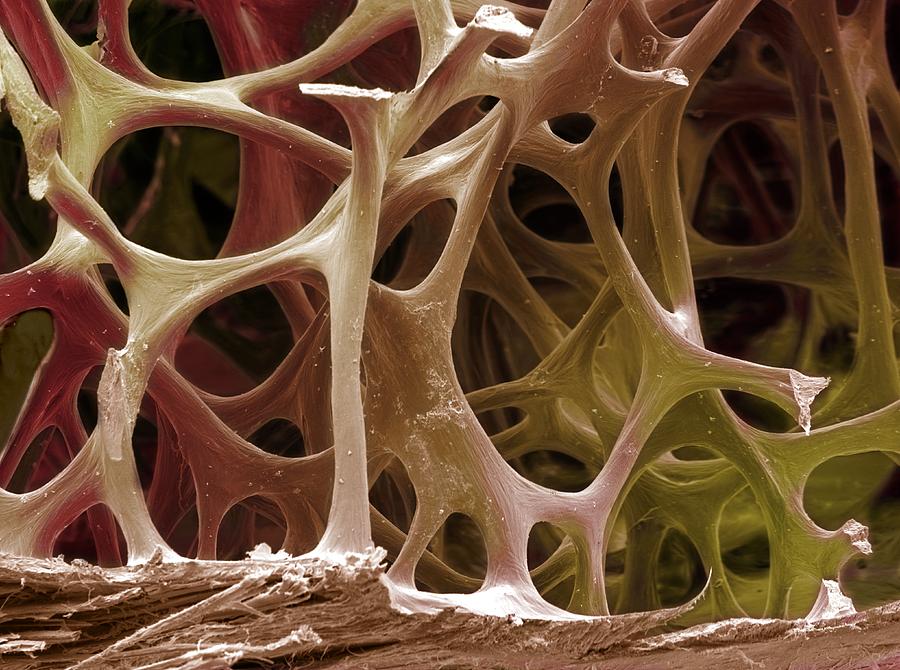
Bird bone tissue. Coloured scanning electron 
micrograph (SEM) of spongy bone from a robin. 
By Steve Gschmeissner.
our sample in the first time, I am delighted to see a microscope, which is one piece of lab equipment I got very comfortable with in my college biology lab classes.  The sample of glass under 10x magnification even looks like bone tissue to me, a gorgeous network of transparent blue struts, similar to the photo at left.  Rather than feeling completely alienated, I feel fairly at home in this high-tech, multi-million dollar physics lab.

In addition to some familiar equipment, all of the people in the lab--both students and Doctor Feller--put me at ease.  They are extremely welcoming, excited to be working there, and happy to share their passions with a novice.  Doctor Feller remembers to point out the physics concepts in basic terms for me and I think I can remember some of the concepts from my introductory level science classes.

All in all, the first day nerves get squelched very quickly and I immediately start learning much faster than I would from a book or article.  On my way out on my first day, I pass a student poster hanging in the hall and stop to read it.  Rather than being confused by the terminology and descriptions of the procedure, I quickly grasp the basics. 


Shards of Glass and Extreme Temperatures

Special Summer Series: Elizabeth Hoover de Galvez from the library's reference department, shares her observations of summer research at Coe. This summer she is working with Dr. Feller's materials science group.
The physics labs on campus are a foreign world where multiple furnaces glow orange at 1800 degrees Fahrenheit, glass is crushed into a powder with shards flying, and liquid nitrogen is pumped from large tanks into instruments where air won't suffice.  It's a place where cosmic rays become visible as sudden peaks on a graph and an electron microscope provides a window to the unimagined textures and structures of the nano-world.

Raman spectrum from a sample of .4 Sodium Borate glass.
The peaks at 771 cm-1 and 498 cm-1 are due, respectively, to the
"breathing" and back and forth vibrations
of the 3,4 coordinated rings.  The hump at 1385 cm-1 is due
to the vibrations of non-bridging oxygens.
Whatever that all means...
To me, it sounds fairly poetic to imagine a molecule breathing, but that is exactly how Dr. Feller describes the structural vibrations of one type of glass, which is apparently evident from the spectrum shown at right.  He explains how the Raman spectroscopy works.  First the machine sends out a laser beam which hits the glass and spreads out over the surface.  Don't quote me on this, but I believe the laser itself is responsible for exciting the molecules so they start vibrating in a new way, as does the beam of laser light.  All of these vibrations, though, are constrained by the structure of the molecules, so the location, height, and steepness of the peaks in the resulting spectrum graph provide clues to the molecules structure.

After skimming through the Wikipedia entries on Raman, spectroscopy, and inelastic scattering, I'm still fairly confused about how all this works...just as I was over 10 years ago when I initially learned about spectroscopy.  But the students don't seem confused--at the first meeting, they were conjecturing about the reasons for the locations of the peaks and asking questions about the slope of the peaks, which seemed to impress Dr. Feller quite a bit.  It's nice to be the outsider who isn't expected to understand everything...far more enjoyable that way.