Showing posts with label archives. Show all posts

Monday, February 15, 2016

Washington's Birthday & the Colonial Ball

Happy Presidents Day! In her early days, Coe would celebrate George Washington's birthday with an assembly that included a debate and a reception hosted by the women students.

1893 Program

1892 Program


From a March 1, 1906  article in the Cosmos, it was mentioned that the women faculty and students of Williston Hall (the original women's dormitory) held a reception and provided refreshments and even little axes as souvenirs.

1924 Colonial Ball

Colonial Ball dance performance 1950s

Starting in 1911, the day's festivities concluded with the Colonial Ball. This was an even where the women students could show off their dance and athletic skills. They would dress in colonial costumes and perform for their fellow Kohawks and members of the public. Two senior women are honored by being named as George and Martha Washington. This tradition continued for many years, the final ball was held in February of 1961.

Wednesday, April 22, 2015

Alumni Spotlight: Clement Pierce Wilson


Since Coe graduated her first class, Kohawks have been doing pretty impressive things. Today's find is a brochure from the 1912 Olympic Games in Stockholm, Sweden. A graduate from Coe, Clement Pierce Wilson, class of 1912, ran in these games. 

Front cover of the 1912 Olympic Games program

He ran in the 4 X 100 meter relay race, the 100 meter race and the 200 meter race. Coe did offer the Clem Wilson Award for track for 50 years after his performance at the Olympics.


Excerpt from the 1913 yearbook
He broke the Iowa state record for the 440 yard race in 49 seconds and then tied the world record in the 100 yard dash (91.44 meters) by running it in only 9.35 seconds! Today that title is held by Asafa Powell, a Jamaican who can run it in 9.07 seconds.

Clem's senior photo
Clem was the captain for the track team his senior year and was also a member of Delta Phi Epsilon. Come and see the whole brochure and other amazing Coe related artifacts down in the archives!

Tuesday, April 14, 2015

On this day in history...

150 years ago today, Abraham Lincoln was fatally shot by John Wilkes Booth while attending a play at Ford's Theater in Washington, D.C.

Only five days before, Confederate General Robert E. Lee surrendered his army in Virginia, ending the American Civil War.

Photo courtesy of the George T Henry Archives, Adams Collection 1734-1879

However, Lincoln didn't die immediately, he passed away the next morning at a lodging house across the street from the theater. Above is a picture of an article from the Buffalo Commercial Advertiser, a newspaper from New York that ran from about 1840-1890.

When the article was written, Lincoln was still alive but not expected to live much longer. The article also describes the attack on Secretary of State William H. Seward on the same night. Seward's fate was much better than Lincoln's and he continued to live for a few more years.

If you're interested in reading the whole article, come down to the George T Henry Archives! This article is part of the Adams Collection, which includes many other newspapers detailing aspects of the Civil war and slavery. The Adams Collection also has many other other documents and artifacts from the mid 1700's to the late 1800's. Click the link under the photo to find out more!

Sunday, March 15, 2015

On this day in history...

Voorhees was occupied for the first time! March 15, 1915 was the first time students spent the night in the dormitory. 

Construction started in mid 1914 and was intended to be finished by the fall semester, but was delayed until late February 1915. It was built to accommodate 65 girls and included included a reception hall, apartments for the dean of women, community bathrooms, a kitchenette, a laundry, and the Frog Pond. Rooms in the dormitory ranged from $120-130 per semester (about $3,000 in today's money).  

Main parlor & music room, around 1915
Credit: George T Henry Archives
The $50,000 to build it was donated by Elizabeth Voorhees, who specifically wanted a dormitory for women. Three years later, she donated again to expand the building to accommodate more students.

Small west parlor, around 1915
Credit: George T Henry Archives

Small west parlor, 2000
Credit: George T Henry

Mary Low Bowers '43, studying in room 339, around 1942
Credit: Kathryn Marie Flew '43

To see even more photos and read articles, handbooks and many other things related to Voorhees, stop by the archives!

Friday, March 13, 2015

"Libraries are becoming museums," says curator Michael Basinki. "Everything is going digital, but we remain tied to the physical objects."

If you ever find yourself at the University of Buffalo, make sure to check out the 2,500 year old Greek and Roman coins.

Top to bottom: a gold aureus of the Roman emperor Otho; a tetradrachm of Athens, showing the busyt of the goddess Athena; a tetradrachm of Alexander the Great, showing Alexander dressed as the god Herakles; a silver tetradrachm of Sicily showing the nymph Arethusa; a gold aureus of the emperor Nero; and a gold otcodrachm of Arsinoe II.
Photo credit: Douglas Levere

The coins were donated to the UB library in 1935 by Thomas Lockwood as part of a larger collection of rare books. However, it wasn't until a professor that focused his research on currency and antiquities checked out the library's rare coin collection that the treasures were really discovered.

The professor, Philip Kiernan, is now developing a graduate course to examine the items' history. It is the first time the coins will be studied specifically.

To view more photographs and for more information about this awesome collection, check out this article from the UB libraries. Want to see even more cool historical artifacts? Stop by the George T Henry archives in the Stewart Memorial Library basement - we may not have Roman coins (or do we?) but we've got some interesting artifacts detailing Coe's history.

Monday, February 16, 2015

It's a bird! It's a plane! It's a...Japanese balloon bomb?

Japanese fire balloon of mulberry paper reinflated at Moffett Field, CA after it had been shot down by a Navy aircraft January 10, 1945
Photo credit: US Army


Just a few months ago, a couple of forestry workers in British Columbia came across a 70 year old inactive Japanese balloon bomb.

Balloon bombs? Yup, they're exactly what they sound like. Balloons made to carry bombs.

Also known as "fire balloons", the Japanese used these as a weapon in World War II. A hydrogen balloon was attached to an antipersonnel bomb - one created specifically to harm humans. They were a cheap weapon designed to make use of the jet stream over the Pacific Ocean and drop those bombs on American and Canadian cities.

Because they solely relied on the wind blowing a certain direction, they were relatively ineffective as weapons, and most landed without harming anyone.

Several have been found from Alaska to Michigan over the years, but a piece of one that landed in Washington has found its way to Coe! It's part of the B.D. Silliman Collection in the archives; Silliman, an alumna of Coe who was an interrogator at the Nuremberg Trials.

Along with the piece of the balloon bomb are Hitler's medical records, interrogations of Nazis and German army insignia. If you're interested in viewing some of the collection, come on down to the archives!

Interested in a little more info about the balloons? This NPR article is a great read.


Thursday, October 24, 2013

What I did last summer.......

Over the summer I worked in the library archives developing a finding aid for part of the William Shirer Collection. Shirer, a journalist from Cedar Rapids popular for his memoirs of fascist Germany and Rise and Fall of the Third Reich, donated his entire collection of documents to the college archives near the end of his career. My job was to read through a collection of his personal correspondence from the year 1979 and create a document that summarized the collection and contained subject headings for important events and persons of note mentioned in the letters.

It was interesting to get a peek into the personal life of a famous author and journalist, as well as see the sorts of acquaintances Shirer had made throughout his life. Many of the letters Shirer received were from aspiring journalists and novelists hoping to get some advice about the writing process. Overall I enjoyed the experience, even if it did get a bit tedious sorting through his letters for the third time. ~~Eric

Thursday, April 25, 2013

The cool, the pretty, and the snarky in the Shirer Collection

I have been working in the George T. Henry Archives in the basement of Stewart Memorial Library for most of this spring semester, wading through and re-organizing just one box of William Shirer correspondence from the 1960s (hey, it has 19 folders!). And let me tell you, that box was a treasure trove of cool letters, pretty handwriting, and plenty of snarky things.

William Shirer is a notable Coe alum, well-known among the history folk for his monumental work The Rise and Fall of the Third Reich, published in late 1960. He wrote mountains of letters and received a ridiculous amount of fan mail praising him and his book, all of which I think I’ve touched at least half a dozen times. So I’d like to share with you some of the more memorable pieces of correspondence in the 1960s box, and maybe you’ll come down and wade through the collection yourself one day to see what snark and praise you can find.

[caption id="" align="alignnone" width="650"]Image Here are two letters from the collection written to Shirer. So many of the handwritten letters in the collection are just gorgeous to look at, it doesn't really even matter what they say![/caption][caption id="" align="alignnone" width="650"]Image Just one example of Shirer's snark. Can't everyone tell the different between Swedish and Norwegian?![/caption]


[caption id="" align="alignnone" width="650"]Image One of my absolute favorites, in which Shirer compares 1960s NYC mail delivery to 1930s Afghanistan... unfavorably. Plus, "Whiz-bang society"? You can't beat that.[/caption][caption id="" align="alignnone" width="650"]Image One of the coolest letterheads. How cool would it be to have letters that say, "from the Inner Sanctum of Stewart Memorial Library, Coe College"?[/caption]

These are just four examples of the pretty letters, snarky letters, and cool letterheads that can be found throughout the Shirer collection and the George T. Henry archives as a whole. Come down, check it out, and maybe even find something to research in the meantime! ~Kristine

Saturday, April 20, 2013

Primary Resources: Electronic Literature Organization

Electronic Literature Organization LogoThe ELO strives "to facilitate and promote the writing, publishing, and reading of literature in electronic media."  It is not a traditional primary resource, but in the 21st century where primary resources are no longer limited to hand written letters, paper documents, and physical objects the "Electronic Literature Organization" is one attempt to capture the intellectual output occurring in the ephemeral digital landscape.
"Electronic literature is born-digital literary art that exploits, as its muse and medium, the transmedia possibilities of the digital. It is, according to the Electronic Literature Organization (ELO), “work with an important literary aspect that takes advantage of the capabilities and contexts provided by the stand-alone or networked computer.”"

Check out their directory of electronic literature containing hypertext, flash, and interactive elements, for a peek at one of trails literature is blazing in the 21st century.

This is one of the resources pinned to the archive’s “Primary Resources” Pinterest board.

~Sara Pitcher, Archives Assistant

Saturday, April 13, 2013

Primary Resources: Voice/Vision Holocaust Survivor Oral History Archive

Voice/Vision Holocaust Survivor Oral History Archive Logo"Vision:...Enable immediate connections to powerful, audio and video-taped oral histories of survivors who experienced the Holocaust"

Since 1981, Dr. Sidney Bolkosky, Professor of History at the University of Michigan-Dearborn, has interviewed Holocaust survivors. The University's Mardigian Library has been the repository of these interviews many of which are available on-line though their "Voice/Vision Holocaust Survivor Oral History Archive".

Beyond these oral histories, the site provides access to finding aids to the University of Michigan-Dearborn's holocaust collections, and links to other holocaust resources on-line.

This is one of the resources pinned to the archive’s “Primary Resources” Pinterest board.

~Sara Pitcher, Archives Assistant

Saturday, April 6, 2013

Primary Resources: Europeana.eu

EuropeanaWhere can you find Mona Lisa by Leonardo da Vinci, the works of Charles Darwin, and the music of Wolfgang Amadeus Mozart?  Why in Europe, of course!  Don't have the time or resources to jump on a plane to see Europe's culture?  Check out Europeana.eu, an internet portal that acts as an interface to millions of books, paintings, films, museum objects and archival records that have been digitized throughout Europe.  Europeana has over 26 millions objects from more than 2,200 institutions scattered among 34 countries, and its still growing.  For just a taste of what you can find, the featured collections this week are: "Royal Book Collections", "Europeana Fasion: Weird and wonderful shoes form the worlds biggest collection", "The Museum of Architecture, Berlin" and "Exhibition: European Sport Heritage".

Prefer getting your history in bit sized portions?  Europeana is on Pinterest, twitter, and facebook.  You can also check out their blog.

This is one of the resources pinned to the archive’s “Primary Resources” Pinterest board.

~Sara Pitcher, Archives Assistant

Saturday, March 30, 2013

Primary Resources: The Civil War Trust

CivilWarKnown for Civil War re-enactments and preserving endangered Civil War battlefields, the Civil War Trust also promotes educational programs. This includes a database of Civil War primary resources including: official records, speeches, acts of congress, correspondence,  photos, maps, and more.  You can also find links to more Civil War document collections.

A chance to read the words of the past.  This is a great resource that can be used for a research paper or a quiet night-in exploring America's history.

Also, check out their Pinterest page, civilwar.org.

This is one of the resources pinned to the archive’s “Primary Resources” Pinterest board.

~Sara Pitcher, Archives Assistant

Saturday, March 23, 2013

Primary Resources: The Newspaper Archives of the Cedar Rapids Public Library

44637184_lxContaining Cedar Rapids, Des Moines, and Marion newspapers from 1853 to the present the Newspaper Archives of the Cedar Rapids Public Library contains over 665,000 newspaper pages.  If you know what you are looking for 1857 to the present is searchable by keyword and date.  If you don't you can browse the newspapers by title or date.

A wealth of local history placed at your finger tips.  I dare you to explore it, perhaps see what was happening in Iowa on the day you were born?

This is one of the resources pinned to the archive's "Primary Resources" Pinterest board.

~Sara Pitcher, Archives Assistant

Saturday, March 16, 2013

Primary Resources: Women's Audio Archive

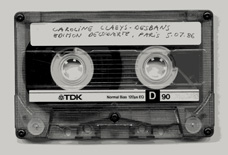
tape_8Art history, cancer, immigration, film theory, Paris, suffragettes...these are just a few keywords from the Women's Audio Archive which is a collection of recordings gathered by Marysia Lewandowska.
The Women's Audio Archive began as a series of recordings, taped by Lewandowska after leaving her home country in 1984, grown out of an interest in language as a site of cultural displacement. These recordings document public events, seminars, talks, conferences, and private conversations as valuable records of a particular time in discourse, beginning around 1983 until 1990.
(from the Women's Audio Archive Introduction)

Lewandowska "is a Polish born artist based in London who, through her collaborative projects, has explored the public function of media archives, collections and exhibitions in an age characterized by relentless privatization." (from Lewandowska's Linked-in Summary)

Did I mention this archive is free?  Lewandowska and a group of curators is working on making the collection fully available in the public domain.  Check the archive out to see the fruits of their efforts.

This is one of the resources pinned to the archive's "Primary Resources" Pinterest board.

~Sara Pitcher, Archives Assistant

Saturday, March 9, 2013

Introducing, the Archive's Pinterest boards

Last week I announced the Archives is now on Pinterest. This week I would like to tell you about the archive's two boards.

"This old Coe - in pictures" is anything and everything Coe College, past and present. An image of our in-coming president David McInally sits next to an old penny postcard depicting Coe campus and a video of Angel & Nick Bitner's May 2012 Wedding held on the campus quad. Alumni and author Ed Gorman sits next to an aerial view of down town Cedar Rapids and a photograph of Coe College's summer athletic camp. Find Coe news, Coe history, Coe people, and Coe anything here.

"Primary Resources" is a board dedicated to just what it says. Materials in any form that are a source of direct evidence describing or documenting a historical event from the perspective of someone who was there. (definition from: UCLA institute of Primary Resources).  You can find links to archival collection finding aids and digital archives here.  Some sources are subscribed to by Coe College (so if you are not on campus you can't access them), many others are free online resources which I have found surfing the web.  They are all great resources for writing papers or just exploring history.

~Sara Pitcher, Archives Assistant

Saturday, March 2, 2013

The Archives is now on Pinterest!

pinterest-1345141049_600

The Coe Archives in now on Pinterest! Check it out.


~Sara Pitcher, Archives Assistant


Saturday, February 23, 2013

Coe Daily Life - The Great Sadie Finkelstein Hoax

"Her arrival, tinged with gossip, was recorded on the calendar of the 1922 Acorn: "Friday, the 17th: 'Sadie' makes her first appearance on the campus for the coming year. Understand that she wears a rock on her left hand." Perhaps the most surprising part of learning of this engagement is the fact that Sadie was not a real person at all."


Created as a joke by students in Professor Leroy Coffin's freshman mathematics class, "Sadie's" name was secretly placed onto the roll sheet, and a female student would quietly say "Here!" to continue the charade. Students went so far as to complete an exam for Sadie after finishing their own, and both the professor and registrar were impressed by the excellent grades Sadie managed to pull in.

And so begins the tale of "The Great Sadie Finkelstein Hoax" dreamed up and perpetrated by the class of 1922.  To hear tell of Sadie's time at Coe, as reported by the Cosmos, check out her article on the site "Coe College: The First Hundred years".

~Sara Pitcher, Archives Assistant

Saturday, February 16, 2013

Coe College Athletics: Mabel Lee

"She did the cake walk for Buffalo Bill. . . she square-danced with Henry Ford. . . Alonzo Stagg called her "Miss Nebraska” . . . she fought to let women be seen on the campus in bloomers and tangled with a sheriff when women danced in flowing chiffon around a May Pole. She is Mabel Lee,” said Roby Kesler in 1978.

Mabel Lee graduated from Coe in 1908.  She returned to Coe in 1910 to spend eight years as the Director of Physical Education for Women.  She startied two (now defunct) Coe traditions her first year: The May Fete, and The Colonial Ball.

Mabel would go on to be the first elected female president of the American Alliance for Health, Physical Education and Recreation and the first female president of the American Academy of Physical Education.  In 1932 she presided over the women's sessions of the Los Angeles Olympics in place of Lady Lou Hoover.  In 1982 Lee was honored by the President's Council on Physical Fitness and Sports as one of the five women in the nation who meant the most to the women of the country in the area of fitness.  This athletic diva refused to slow down and at the age of 85 began a career as an author.  She published four books before her death at the ripe age of 99.  There is much more to know about her story.  You can read the full article on Mabel Lee on "Coe College: the First Hundred Years" along with many other tales of athletics at Coe.

~Sara Pitcher, Archives Assistant

Saturday, February 9, 2013

Coe College Campus: The Victory Bell

Another week, another tab on the site “Coe College: the First Hundred Years.”   This week it is 'The Campus', containing 'The Buildings of Coe' and 'The Attractions of Coe'.  One attraction being the "Victory Bell".
The Victory Bell: Celebrating 76 Years of Victories

“O mighty bell, thy power is great;
Your vibrant tones ecstatic swell,
And speak again of kindly fate
Thy notes are notes we all love well.


Ring out and tell of vict’ry won,
With penetrating tones, O bell.
Whene’er you speak, to live is fun;
When you keep still, to live is –!”


Roteiv
Cosmos November 12, 1925

Students first encounter the Victory Bell during orientation week when they ring it to signal the beginning of their career at the college.  This tradition, having begun in 1992, is relatively new to the bell .  The bell itself is also new having been donated by the class of 2000, but the tradition of a Victory Bell goes back to 1913.

The class of 1913 were the first to donate a Victory Bell to the college.  Athletics at Coe was going through a loosing streak at the time and the students decided that the athletes needed more collegiate support, hence the Victory Bell was born.  Over the years the bell has been apart of many traditions, been many bells, and traveled around the campus to many locations.  Check out the article, "The Victory Bell" on “Coe College: the First Hundred Years” to read the full story of it's journey.

~Sara Pitcher, Archives Assistant