Over the summer I worked in the library archives developing a finding aid for part of the William Shirer Collection. Shirer, a journalist from Cedar Rapids popular for his memoirs of fascist Germany and Rise and Fall of the Third Reich, donated his entire collection of documents to the college archives near the end of his career. My job was to read through a collection of his personal correspondence from the year 1979 and create a document that summarized the collection and contained subject headings for important events and persons of note mentioned in the letters.
It was interesting to get a peek into the personal life of a famous author and journalist, as well as see the sorts of acquaintances Shirer had made throughout his life. Many of the letters Shirer received were from aspiring journalists and novelists hoping to get some advice about the writing process. Overall I enjoyed the experience, even if it did get a bit tedious sorting through his letters for the third time. ~~Eric
Showing posts with label primary documents. Show all posts
Showing posts with label primary documents. Show all posts
Thursday, October 24, 2013

Saturday, April 27, 2013
Primary Resources: Coe Archive's Collections
 Founder's Papers (1851-1881), LeRoy Weld Diaries (1894-1955), Western College Collection (1857-1906) , and the Paul Engle Papers (1927-1991) all have two things in common. They are collections housed in the George T. Henry College Archives , and they are featured on the archive's Primary Resources Pinterest page. A sampling of what the archives hold, each of these collections has an on-line finding aid that can be accessed anywhere, and for anyone near Coe College (or looking for a destination for a road trip) primary resources that can be viewed, held and scrutinized outside of the digital world.
Check out more of the archives collections in the left hand column on its Collections page.
~Sara Pitcher, Archives Assistant
Saturday, April 20, 2013
Primary Resources: Electronic Literature Organization
 The ELO strives "to facilitate and promote the writing, publishing, and reading of literature in electronic media." It is not a traditional primary resource, but in the 21st century where primary resources are no longer limited to hand written letters, paper documents, and physical objects the "Electronic Literature Organization" is one attempt to capture the intellectual output occurring in the ephemeral digital landscape.
"Electronic literature is born-digital literary art that exploits, as its muse and medium, the transmedia possibilities of the digital. It is, according to the Electronic Literature Organization (ELO), “work with an important literary aspect that takes advantage of the capabilities and contexts provided by the stand-alone or networked computer.”"
Check out their directory of electronic literature containing hypertext, flash, and interactive elements, for a peek at one of trails literature is blazing in the 21st century.
This is one of the resources pinned to the archive’s “Primary Resources” Pinterest board.
~Sara Pitcher, Archives Assistant
Saturday, April 13, 2013
Primary Resources: Voice/Vision Holocaust Survivor Oral History Archive
 "Vision:...Enable immediate connections to powerful, audio and video-taped oral histories of survivors who experienced the Holocaust"
Since 1981, Dr. Sidney Bolkosky, Professor of History at the University of Michigan-Dearborn, has interviewed Holocaust survivors. The University's Mardigian Library has been the repository of these interviews many of which are available on-line though their "Voice/Vision Holocaust Survivor Oral History Archive".
Beyond these oral histories, the site provides access to finding aids to the University of Michigan-Dearborn's holocaust collections, and links to other holocaust resources on-line.
This is one of the resources pinned to the archive’s “Primary Resources” Pinterest board.
~Sara Pitcher, Archives Assistant
Saturday, April 6, 2013
Primary Resources: Europeana.eu
 Where can you find Mona Lisa by Leonardo da Vinci, the works of Charles Darwin, and the music of Wolfgang Amadeus Mozart? Why in Europe, of course! Don't have the time or resources to jump on a plane to see Europe's culture? Check out Europeana.eu, an internet portal that acts as an interface to millions of books, paintings, films, museum objects and archival records that have been digitized throughout Europe. Europeana has over 26 millions objects from more than 2,200 institutions scattered among 34 countries, and its still growing. For just a taste of what you can find, the featured collections this week are: "Royal Book Collections", "Europeana Fasion: Weird and wonderful shoes form the worlds biggest collection", "The Museum of Architecture, Berlin" and "Exhibition: European Sport Heritage".
Prefer getting your history in bit sized portions? Europeana is on Pinterest, twitter, and facebook. You can also check out their blog.
This is one of the resources pinned to the archive’s “Primary Resources” Pinterest board.
~Sara Pitcher, Archives Assistant
Saturday, March 30, 2013
Primary Resources: The Civil War Trust
 Known for Civil War re-enactments and preserving endangered Civil War battlefields, the Civil War Trust also promotes educational programs. This includes a database of Civil War primary resources including: official records, speeches, acts of congress, correspondence, photos, maps, and more. You can also find links to more Civil War document collections.
A chance to read the words of the past. This is a great resource that can be used for a research paper or a quiet night-in exploring America's history.
Also, check out their Pinterest page, civilwar.org.
This is one of the resources pinned to the archive’s “Primary Resources” Pinterest board.
~Sara Pitcher, Archives Assistant
Saturday, March 23, 2013
Primary Resources: The Newspaper Archives of the Cedar Rapids Public Library
 Containing Cedar Rapids, Des Moines, and Marion newspapers from 1853 to the present the Newspaper Archives of the Cedar Rapids Public Library contains over 665,000 newspaper pages. If you know what you are looking for 1857 to the present is searchable by keyword and date. If you don't you can browse the newspapers by title or date.
A wealth of local history placed at your finger tips. I dare you to explore it, perhaps see what was happening in Iowa on the day you were born?
This is one of the resources pinned to the archive's "Primary Resources" Pinterest board.
~Sara Pitcher, Archives Assistant
Saturday, March 16, 2013
Primary Resources: Women's Audio Archive
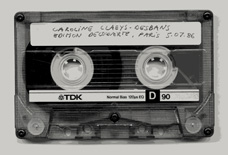 Art history, cancer, immigration, film theory, Paris, suffragettes...these are just a few keywords from the Women's Audio Archive which is a collection of recordings gathered by Marysia Lewandowska.
The Women's Audio Archive began as a series of recordings, taped by Lewandowska after leaving her home country in 1984, grown out of an interest in language as a site of cultural displacement. These recordings document public events, seminars, talks, conferences, and private conversations as valuable records of a particular time in discourse, beginning around 1983 until 1990.
(from the Women's Audio Archive Introduction)
Lewandowska "is a Polish born artist based in London who, through her collaborative projects, has explored the public function of media archives, collections and exhibitions in an age characterized by relentless privatization." (from Lewandowska's Linked-in Summary)
Did I mention this archive is free? Lewandowska and a group of curators is working on making the collection fully available in the public domain. Check the archive out to see the fruits of their efforts.
This is one of the resources pinned to the archive's "Primary Resources" Pinterest board.
~Sara Pitcher, Archives Assistant
Saturday, March 9, 2013
Introducing, the Archive's Pinterest boards
Last week I announced the Archives is now on Pinterest. This week I would like to tell you about the archive's two boards.
"This old Coe - in pictures" is anything and everything Coe College, past and present. An image of our in-coming president David McInally sits next to an old penny postcard depicting Coe campus and a video of Angel & Nick Bitner's May 2012 Wedding held on the campus quad. Alumni and author Ed Gorman sits next to an aerial view of down town Cedar Rapids and a photograph of Coe College's summer athletic camp. Find Coe news, Coe history, Coe people, and Coe anything here.
"Primary Resources" is a board dedicated to just what it says. Materials in any form that are a source of direct evidence describing or documenting a historical event from the perspective of someone who was there. (definition from: UCLA institute of Primary Resources). You can find links to archival collection finding aids and digital archives here. Some sources are subscribed to by Coe College (so if you are not on campus you can't access them), many others are free online resources which I have found surfing the web. They are all great resources for writing papers or just exploring history.
~Sara Pitcher, Archives Assistant
Monday, December 10, 2012
Books!!!!
My favorite thing about working at the library is seeing just what an extensive collection of books that it has to offer. Although I had spent time studying in the library last year (before I had a job at the circulation desk) I hadn’t taken advantage of using the books for various research products. I think one of the reasons why I didn’t do this is because I went to an extremely small high-school that didn’t have a very extensive collection of books. They had always encouraged us to use the library in high-school, but most of the time they just didn’t have enough books for me to find what I was looking for.
So this year, after I got the job at the library and started doing tasks like shelving and inventory, I was amazed by the multitude of different book topics that the library housed. Even now, four months into the job I still get shocked that there are shelves and shelves of books on a single topic. So last month when I had a big research paper due for Chemistry, instead of only using online sources I checked the library database and was able to find tons of books about my topic. They were very helpful tools for my paper and I’m glad that I now go to a school that has a great library!~Bellamy, Circulation Student
Thursday, April 12, 2012
Bert H. Baily Museum, Coe College, Iowa (1885-2004)
 From the Archives…
Did you know Coe had a museum? When Coe College was incorporated in 1881 is was common for college’s to have their own museums. In fact it was a point of prestige for a college to have a museum, which is why the Coe College Museum was begun in 1885, three years after Coe instituted a library and five years before it had a student newspaper. Part of the museum was still used by students as late as 2004 when art classes used the preserved birds as drawing subjects.
Today the space has been turned into much-needed classrooms, but pieces of the museum’s history still occasionally show up in the archives. With the cleaning out of Peterson hall, in advance of its renovation this summer, a box of museum correspondence and notes was discovered by Harlo Hadow (Heins-Johnson Professor of Biology) and brought to the archives. The identification cards on the right are part of this recent accession to the museum’s recorded history.
~Sara, Archives Assistant
Thursday, March 22, 2012
Flunk Day (looking back, 1911)
from the archives...
The first flunk day was announced by a notice posted at chapel (which students were required to attend) and plastered across campus in classrooms and outside walls. It encouraged everyone to "give his intellectual organ a short respite" by cutting classes", and kindly requested the faculty to lend "their cooperation by taking their wives and going on a picnic."

The students followed suit and headed to the Cedar River for a day of picnicking and boating. The day was enough of a success that the tradition has lasted a hundred and one years past the first one held on May 3, 1911.

For more Flunk Day history you can visit Coe's digital exhibit of Flunk Day posters.
Till next Thursday
Sara
P.S. Thank you Anna for your questions. I will make sure to answer them next week. I am still open to questions: what do you want to see a blog post on?
Thursday, February 16, 2012
Third Largest Collection
From the Archives…
If you have been keeping up with “From the archives” posts you know that the largest collection in the George T. Henry College Archives is the Coe Collection, the second largest is William L. Shirer’s Papers and the third is…a bit of a toss up actually. George T. Henry’s Photograph Collection rivals Shirer’s collection in size with approximately 100,000 negatives, 60,000 proof sheets, and 9,000 images for browsing. His black and white photographs span more than 50 years of Coe History. But, since he was employed by Coe his collection could be considered part of the Coe Collection. So, if the esteemed photographer’s collection is out on a technicality whose collection gets the title third largest in the archives?
Paul Engle graduated from Coe in 1931. In 1932 he obtained his masters from the University of Iowa. His thesis, a collection of poems titled “Worn Earth”, was among the first creative pieces accepted in higher education for completion of a masters degree. It was published by Yale University Press that same year. Engle then went on to win a Rhodes Scholarship to Oxford University where he studied under Edmund Blunden.
[caption id="attachment_451" align="aligncenter" width="207" caption="Paul Engle"] [/caption]
Engle returned to the University of Iowa in 1937 as a faculty member in the English department with a focus on poetry. In 1941 he took up the directorship of the Iowa Writers Workshop which he successfully ran until 1965. Two years later Engle and his wife Hualing Nieh founded the University of Iowa's International Writing Program. In 1976 Engle was nominated for a Nobel Peace Prize by close friend Averell Harriman who commended the Engles for “bring[ing] peace and understanding to the world by bringing writers of every country, language and culture to their program”.
Engle wrote and edited more than 20 books, was a frequent contributor to poetry journals, scholarly journals, and popular magazines. His book reviews appeared in the New York Times.
The Paul Engle Papers, housed in the archives, consists of 18 linear feet (63 boxes) of material containing his correspondence, poetry drafts, manuscript drafts, galleys, publications and personal papers. It also has the distinction of being the third largest collection in the George T. Henry College Archives.
If you have been keeping up with “From the archives” posts you know that the largest collection in the George T. Henry College Archives is the Coe Collection, the second largest is William L. Shirer’s Papers and the third is…a bit of a toss up actually. George T. Henry’s Photograph Collection rivals Shirer’s collection in size with approximately 100,000 negatives, 60,000 proof sheets, and 9,000 images for browsing. His black and white photographs span more than 50 years of Coe History. But, since he was employed by Coe his collection could be considered part of the Coe Collection. So, if the esteemed photographer’s collection is out on a technicality whose collection gets the title third largest in the archives?
Paul Engle graduated from Coe in 1931. In 1932 he obtained his masters from the University of Iowa. His thesis, a collection of poems titled “Worn Earth”, was among the first creative pieces accepted in higher education for completion of a masters degree. It was published by Yale University Press that same year. Engle then went on to win a Rhodes Scholarship to Oxford University where he studied under Edmund Blunden.
[caption id="attachment_451" align="aligncenter" width="207" caption="Paul Engle"]
 [/caption]
Engle returned to the University of Iowa in 1937 as a faculty member in the English department with a focus on poetry. In 1941 he took up the directorship of the Iowa Writers Workshop which he successfully ran until 1965. Two years later Engle and his wife Hualing Nieh founded the University of Iowa's International Writing Program. In 1976 Engle was nominated for a Nobel Peace Prize by close friend Averell Harriman who commended the Engles for “bring[ing] peace and understanding to the world by bringing writers of every country, language and culture to their program”.
Engle wrote and edited more than 20 books, was a frequent contributor to poetry journals, scholarly journals, and popular magazines. His book reviews appeared in the New York Times.
The Paul Engle Papers, housed in the archives, consists of 18 linear feet (63 boxes) of material containing his correspondence, poetry drafts, manuscript drafts, galleys, publications and personal papers. It also has the distinction of being the third largest collection in the George T. Henry College Archives.
Friday, January 27, 2012
1851
From the Archives…
Does 1851 sound familiar to you? Perhaps you noticed it on the Coe seal or on the large stone sign at the corner of campus? In 1851 Williston Jones, Coe College’s founder, opened his home to Cedar Rapids youth with the intention of preparing them for the ministry. Two years later, during a trip to New York, Jones took to the pulpit to raise funds to send his students to seminary, and found a man with another idea. Daniel Coe was willing to give Jones 1500 dollars if he started a school in Cedar Rapids, Iowa.
Are you curious about what happened next? Coe has several historical accounts telling the story of Coe’s beginnings including an account on Coe’s website, the Writing Center’s website on the first 100 years of Coe College, a digital exhibit on Coe’s founders and of course the Coe College Founders Papers in the archives.
~Sara
Tuesday, November 29, 2011
From the Archives...Coe has an Archive?
Student: Coe has an archive?
Archives Assistant (Sara): Yes! The George T. Henry College Archives (Coe's archives) is located in the basement of Stewart Memorial Library.
Student: What is an archive?
Sara: An archives is a library that contains primary documents (original material such as correspondence, meeting minutes, newspapers, and manuscripts) and collections about people, places or things.
The Coe Archives specializes in collections about or relating to Coe College, including its history, its students, its alumni, and all things Coe related.
Student: Who is this George guy?
Sara: George T. Henry was the college photographer for 50 years. You can still occasionally see him taking pictures around campus today, even though he’s retired. The archive holds over 10,000 negatives of photographs taken of Coe by George. You can see a sampling of these photographs on the archive’s walls.
Student: Can I use the archives?
Sara: Yes, Yes, YES (I am so glad you asked). Students, faculty, and staff can use the archive for research, projects, or papers. We have material from poets, WWII correspondents, Physics professors, and on any number of topics. Our material is listed in the Library Catalog, or you can ask a librarian to help you find something in our collections.
~Sara
Subscribe to:
Posts (Atom)